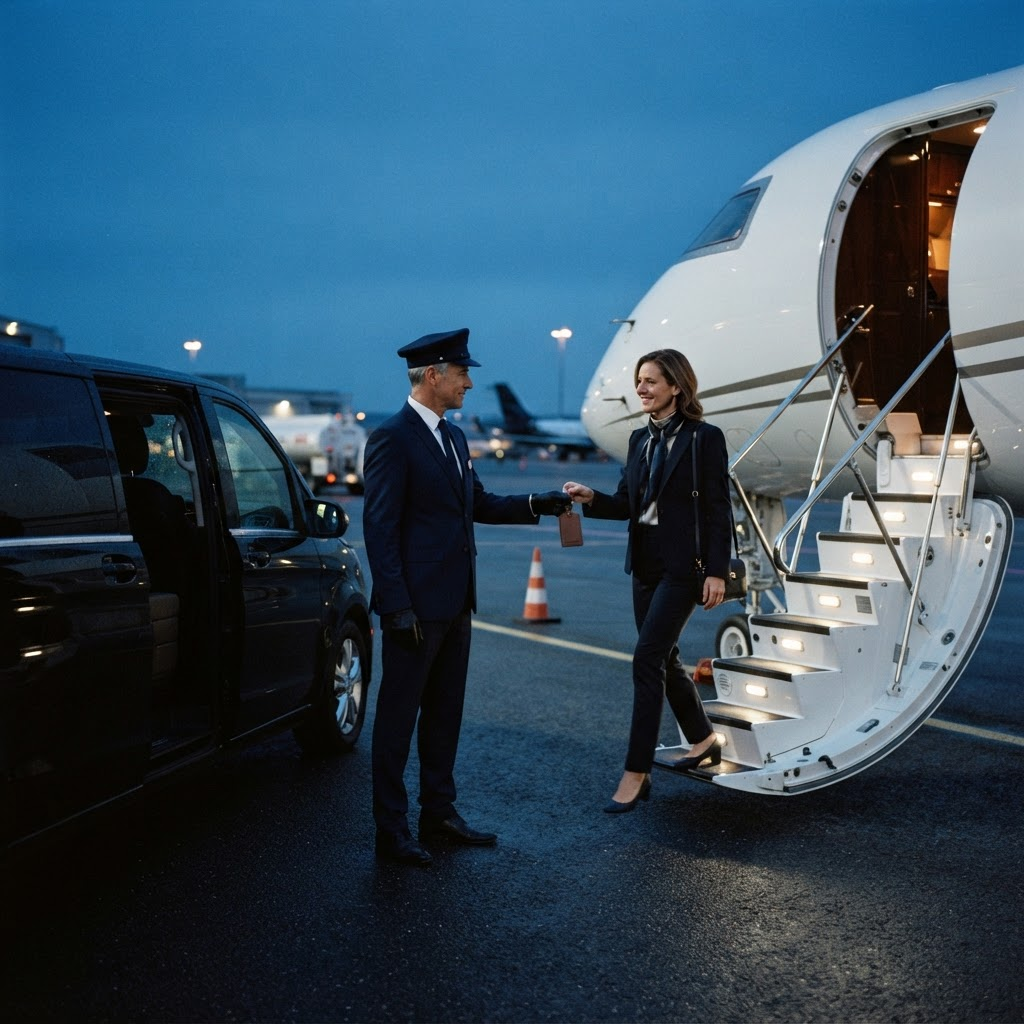
What it actually means for ground transport to be bound to the flight plan — and why it is the technical foundation that makes a corridor network reliable.
Flight-synced dispatch is a phrase used loosely across the industry. For us it has a precise meaning: every ground assignment is bound to a live flight object — tail number, route and revised ETA — rather than a static pickup time typed in at booking. That distinction is the difference between reacting to delays and anticipating them.
The mechanics
- Each transfer is linked to its aircraft's flight plan the moment it is confirmed.
- Position, ETA and destination FBO are tracked continuously from wheels-up to wheels-down.
- Material changes — delays, diversions, early arrivals — push automatically to the dispatch board and to the assigned operator.
- Vehicle timing recalculates against the revised wheels-down, not the original clock time.
Why it matters for operators
For a partner operator, flight-synced dispatch removes the two most common failure modes in private ground transport: waiting hours on a delayed arrival with a meter running, or missing an early one entirely. Instead of guessing, the operator receives an accurate, continuously updated arrival window and a clear instruction if the aircraft diverts. Assignments become more predictable and more profitable, and the client never sees the seam.
The foundation beneath the experience
Everything else TŌGE promises — planeside timing, weather re-staging, a single point of contact — rests on this foundation. You cannot coordinate a corridor you cannot see. Flight-synced dispatch is what gives the whole network a shared, real-time picture of every journey in motion.
Run a corridor to this standard?
Join a flight-synced network that fills your calendar with premium, well-coordinated work.